Good Chinese-style prompts name a specific tradition instead of saying “Chinese style”. Ink wash needs ink tones and empty space; Dunhuang needs flying apsaras, ribbons and mineral blues and reds; gongbi needs fine outlines and layered color; guochao needs traditional motifs in a modern visual language.
Why “Chinese style” isn’t enough
“Chinese style” covers Song dynasty landscapes, Tang dynasty cave murals, Ming blue-and-white porcelain and today’s streetwear graphics — visually, they have almost nothing in common. With only the umbrella term, the model returns an average: red lanterns and curved eaves, often blended with other East Asian looks.
A strong prompt has four parts: tradition + subject + traditional palette + mood and layout.
| Tradition | What it is | Key words | Palette | Suggested setting |
|---|---|---|---|---|
| Ink wash (shuimo) | Expressive monochrome brush painting | ink gradations, dry brush, mist, empty space, rice paper | Black, grays, a touch of ochre | Chinese Ink preset |
| Dunhuang murals | Buddhist cave paintings on the Silk Road, 4th–14th c. | flying apsaras, ribbons, auspicious clouds, weathered plaster | Azurite, malachite, cinnabar, ochre, gold | Scene type |
| Gongbi | Meticulous, finely outlined color painting | fine line work, layered washes, painted on silk | Refined mineral colors | Scene type |
| Blue-green landscape | Panoramic mountains in mineral blues and greens | layered peaks, gold outlines, handscroll | Azurite, malachite, gold | Scene type, 16:9 |
| Guochao | “National trend” — modern design built on Chinese motifs | zodiac, seasonal terms, patterns, bold color | High-contrast, saturated | 3D Cartoon or Flat |
A note on settings: the Scene type renders rich painterly detail and follows briefs like ink, watercolor or anime; the Illustration type renders flat vector art, which suits guochao graphics but flattens gongbi detail. For gongbi and Dunhuang, choose Scene, skip the ink preset and describe the tradition in the prompt. And since the engine reads Chinese natively, you can drop terms like 水墨 or 工笔 straight into an English prompt.
Ink wash: write the ink and the emptiness
Ink painting lives on ink tones — dense, pale, wet, dry — and on generous empty paper. Without those words, the model tends to produce a gray landscape photo instead of a painting.
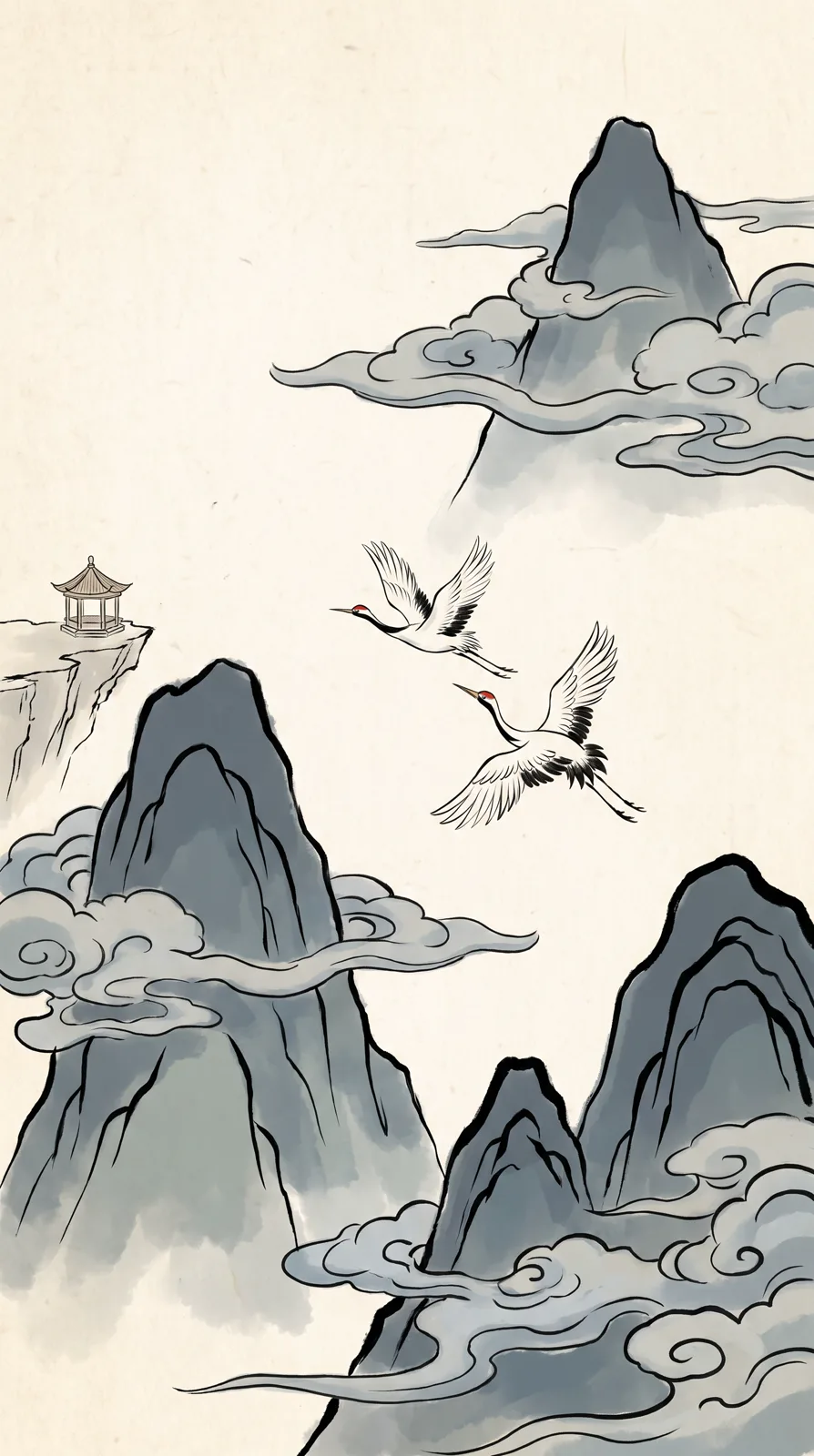
Prompt idea: two cranes over mist-wrapped ink-wash peaks, a small pavilion far off, Chinese Ink style, 9:16. Full prompt on the image page.
Expressive ink wash landscape, distant blue-black mountains, a few old pines in front, a lone boat moored by the river, varied ink tones, generous empty space, rice paper texture
Ink painting of a lotus pond in autumn, withered lotus leaves and a kingfisher, wet brush washes, sparse quiet mood
A water town after snow, white walls and dark tiles, a stone bridge and a canopied boat, pale ink washes, still and cold
The 9:16 frame echoes a hanging scroll and works as a phone wallpaper too.
Dunhuang: write “mural” and “mineral pigment”
The Mogao Caves at Dunhuang hold a thousand years of Buddhist murals. Their look comes from three things: the swirling motion of apsaras and ribbons, mineral pigments such as azurite and cinnabar, and the weathered texture of ancient plaster.
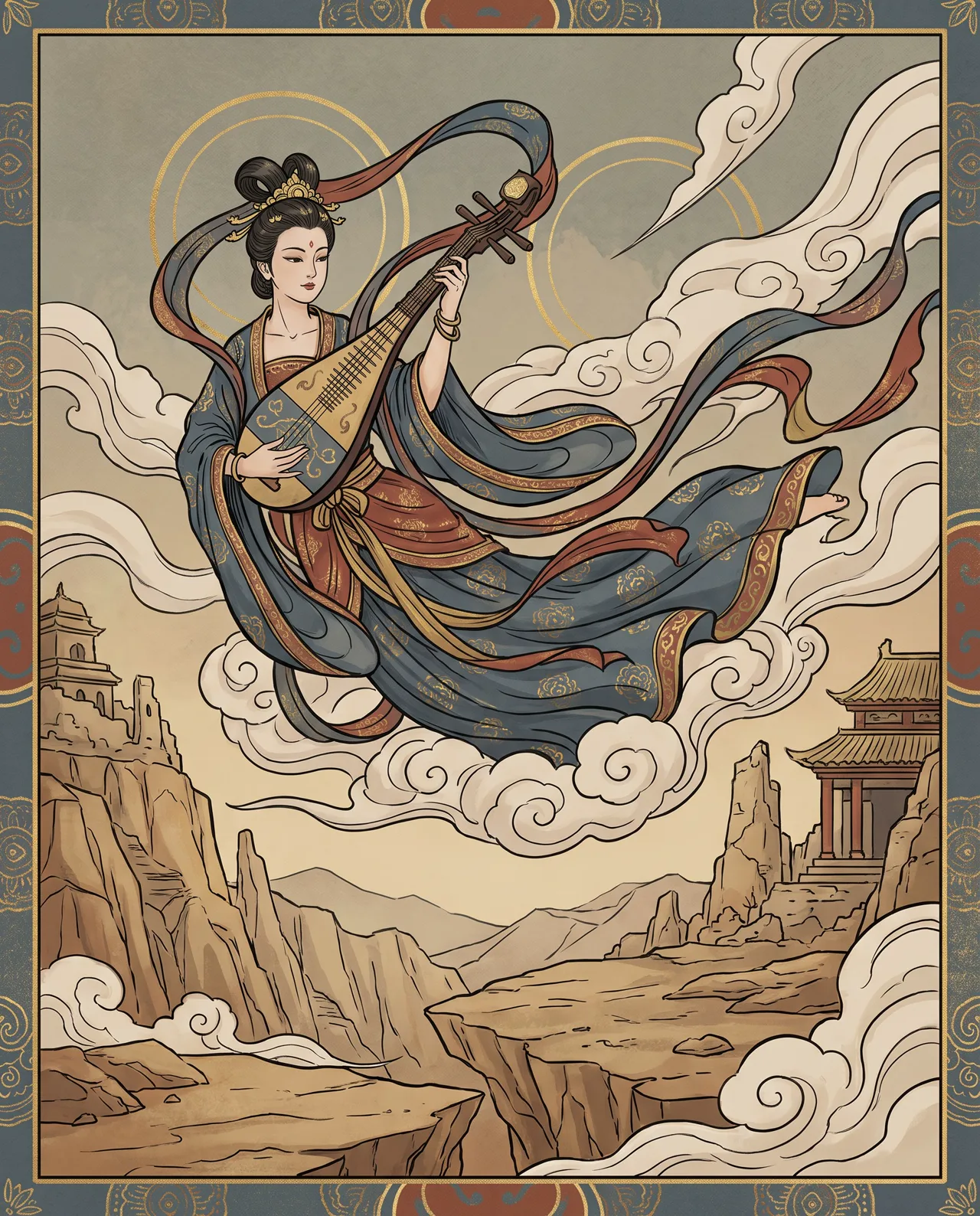
Prompt idea: a flying apsara in Dunhuang mural style, ribbons flowing, holding a pipa, azurite, cinnabar and gold, 4:5.
Dunhuang mural-style celestial musician playing a flute, ribbons circling, auspicious clouds and lotus motifs, azurite, malachite and ochre, weathered mural texture
A Dunhuang caisson ceiling pattern, a blooming lotus at the center, rings of scrolling vines and apsaras, cinnabar against azurite, symmetrical
A nine-colored deer walking through mountains, Dunhuang mural lines and colors, ochre background, solemn and ancient
One caution: the AI makes new work in the Dunhuang style. Don’t market it as an original mural or an officially licensed product; see our guide to commercial use of AI images.
Gongbi and blue-green landscapes: write the line and the color
Gongbi means “meticulous brush”: fine outlines filled with color applied in many thin layers. Stress precision:
Gongbi bird-and-flower painting, a golden pheasant perched on a blooming peony branch, fine line work, layered washes, color on silk, rich and elegant
Gongbi portrait of a Tang dynasty lady in a high-waisted ruqun dress holding a round fan under banana leaves, delicate lines, soft colors
Blue-green landscapes use azurite and malachite with gold outlines; at 16:9 they suggest the sweep of a handscroll:
Blue-green landscape handscroll, layered peaks in azurite and malachite, gold outlines on rocks, pavilions and a small bridge among the mountains, a wide river
Guochao: tradition in a modern voice
Guochao — literally “national trend” — is the wave of contemporary Chinese design that remixes heritage motifs. It doesn’t imitate old brushwork; it puts tradition into 3D, flat or cyberpunk visuals.
A 3D cartoon ginger cat wearing a lion-dance head, red and gold, auspicious clouds and firecrackers, festive (3D Cartoon)
A future city street mixing blue-and-white porcelain patterns with neon signs, blue and white with neon pink accents (Cyberpunk)
Start of Autumn seasonal illustration, ginkgo leaves, a round fan and a cup of tea, muted warm colors, empty space at the top (Flat)
Add festival names, years and seasonal titles afterward; our AI poster workflow explains how.
A vocabulary of Chinese imagery
| Category | Words that work |
|---|---|
| Landscape mood | mist-wrapped peaks, layered ridges, distant blue-black hills, a lone fisherman on a cold river |
| Bird and flower | plum, orchid, bamboo and chrysanthemum; lotus pond under moonlight; sparrows on a bare branch |
| Traditional colors | indigo-black, moon white, rouge, lotus-root pink, ochre, gilded gold, celadon sky blue |
| Objects and architecture | celadon teacup, round silk fan, palace lantern, hip-and-gable roof, moon gate, canopied boat |
| Layout | generous empty space, hanging-scroll vertical, handscroll panorama, fan-shaped composition |
Fixing common problems
- Looks Japanese or Korean: name a dynasty, garment or object — “Song dynasty robes”, “hip-and-gable roof”.
- Fake calligraphy and seals: don’t ask for inscriptions; add real ones later.
- Too bright and modern: add “muted”, “antique”, “aged paper texture”.
- Ink painting looks like a gray photo: use the Chinese Ink preset or the Scene type, and include painting words like “ink gradations” and “rice paper”.
For how these compare with other looks, see our AI art styles guide. Then try your prompt in the AI illustration generator, or start from the Chinese-style section of the prompt library.